Paperback
Paperback
6 × 9, 170 pages, printed on demand through Amazon. Released September 3, 2026.
Buy Paperback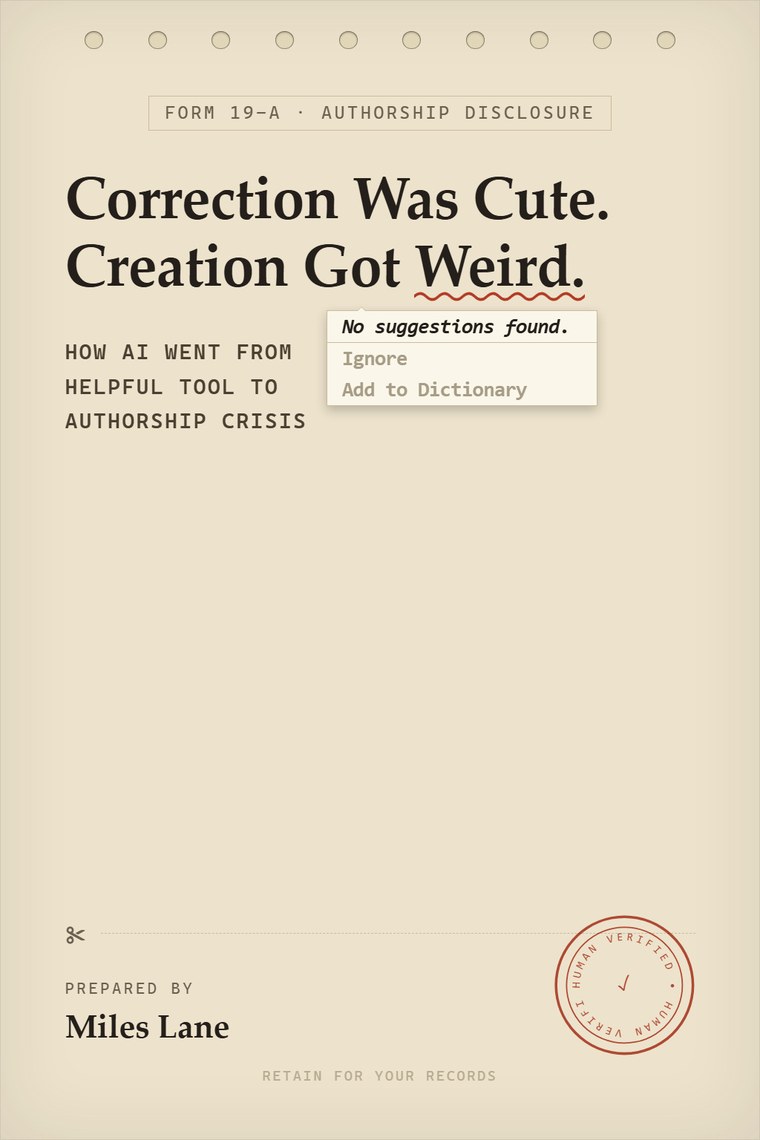
People loved AI when it corrected the picture. They panicked when it could enter the picture.
Available now in paperback and Kindle.
Correction Was Cute. Creation Got Weird. isn't a book that tells you to love AI or hate it — the author is upfront that pretending there's a clean answer would be dishonest.
For decades, machines helped us spell, drive, shop, calculate, take photos, avoid traffic, find songs, and flag fraud. Nobody called it cheating. We called it convenient. Then AI learned to write, draw, speak, imitate, and invent, and suddenly everyone got very concerned about what was “real.”
It's a funny, honest, occasionally self-deprecating tour through machine assistance old and new — spellcheck, GPS, autofocus, and actuarial tables, all the way to chatbots, image generators, and deepfakes — built around one question the rest of the conversation keeps skipping: did it help a human become more capable, or did it just make weakness look polished?
This isn't a manifesto with a verdict at the end. It reads more like a conversation with someone who has actually used the tools, noticed the weird parts, and isn't finished thinking about it either.
Introduction
“The first AI many of us loved was spellcheck, which is funny because spellcheck has been publicly humiliating us for years.”
“Buttons did a lot of public relations for machines.”
“Good formatting has talked a lot of nonsense past security.”
“A tool does not become wise because it is powerful.”
“Did it help a human become more capable, or did it just make weakness look polished?”

Miles Lane writes about the ordinary, absurd, and occasionally uncomfortable ways technology changes daily life before anyone has agreed on what to call it. His work sits in the space between humor, practical skepticism, and the strange little ethical questions that show up after a tool has already become normal.
In Correction Was Cute. Creation Got Weird., Lane looks at artificial intelligence without treating it as magic, doom, or a productivity slogan. The book asks a simpler and more useful question: did the tool help a person become more capable, or did it only make weakness look polished?
He is especially interested in the blurry middle of modern technology: spellcheck, GPS, recommendation engines, image tools, chatbots, automation, and all the moments when people discover they were comfortable with machine assistance right up until the machine started sounding creative.
This is my work: my ideas, my arguments, my jokes, and my judgment. Tools helped with editing, structuring, formatting, and drafting along the way. I am not pretending a fake person wrote this, and I am not passing off someone else’s work as mine.
If that bothers you, I understand. I’d encourage you to read Chapter 16 before you decide how much it should.
— Miles Lane, on how this book was made
6 × 9, 170 pages, printed on demand through Amazon. Released September 3, 2026.
Buy PaperbackRead on any Kindle device or the free Kindle app.
Buy KindleThe paperback is available now. The Kindle edition is available now. Additional retailers will be added here once confirmed.